ASTRONOMY & SPACE
GREAT brought high-resolution far-infrared spectroscopy to the airborne SOFIA observatory. CRYOVAC manufactured its cryostats.
Why cryogenics matters
Liquid-helium and liquid-nitrogen cooling supported sensitive receiver operation. The instrument paper describes its modular design and performance during early science flights.
Publications
Context & publication summaries- 01
S. Heyminck, U. U. Graf, R. Güsten, J. Stutzki, H. W. Hübers & P. Hartogh · 2012
GREAT: the SOFIA high-frequency heterodyne instrument
Instrument architecture, receiver technology and in-flight commissioning results.
DOI 10.1051/0004-6361/201218811 · arXiv:1203.2845
Sources & references
- arxiv.org/html/1203.2845v1
- arxiv.org/abs/1203.2845
- doi.org/10.1051/0004-6361/201218811
ASTRONOMY & SPACE
MICADO is a near-infrared camera for the ELT, developed by an international consortium led by MPE. CRYOVAC built its cryostat.
Cold optics, faint signals
The cryostat houses cold optics and detectors. Cooling suppresses the instrument’s own thermal emission; adaptive optics corrects atmospheric blurring before the image reaches the camera.
Publications
Context & publication summaries- 01
R. Davies et al. · 2016
MICADO: first light imager for the E-ELT
An overview of observing modes, the optical concept and mechanisms inside the cryostat.
DOI 10.1117/12.2233047 · arXiv:1607.01954
- 02
J.-U. Pott et al. · 2018
The MICADO first light imager for ELT: its astrometric performance
The astrometric design: measuring stellar positions precisely, with calibration and distortion control.
DOI 10.1117/12.2312069 · arXiv:1807.07402
- 03
R. Davies et al. · The MICADO Consortium · 2021
MICADO: The Multi-Adaptive Optics Camera for Deep Observations
A readable introduction to the camera’s observing capabilities and the astronomy they enable.
DOI 10.18727/0722-6691/5217 · The Messenger 182, 17–21
Sources & references
- www.mpe.mpg.de/ir/micado
- www.mpe.mpg.de/8022687/picturegallery
- elt.eso.org/instrument/MICADO/
- arxiv.org/abs/1607.01954
- doi.org/10.1117/12.2233047
- doi.org/10.1117/12.2312069
- doi.eso.org/10.18727/0722-6691/5217
- doi.org/10.18727/0722-6691/5217
ASTRONOMY & SPACE
ESO’s Extremely Large Telescope is being built on Cerro Armazones in Chile. Its 39-metre primary mirror collects visible and near-infrared light.
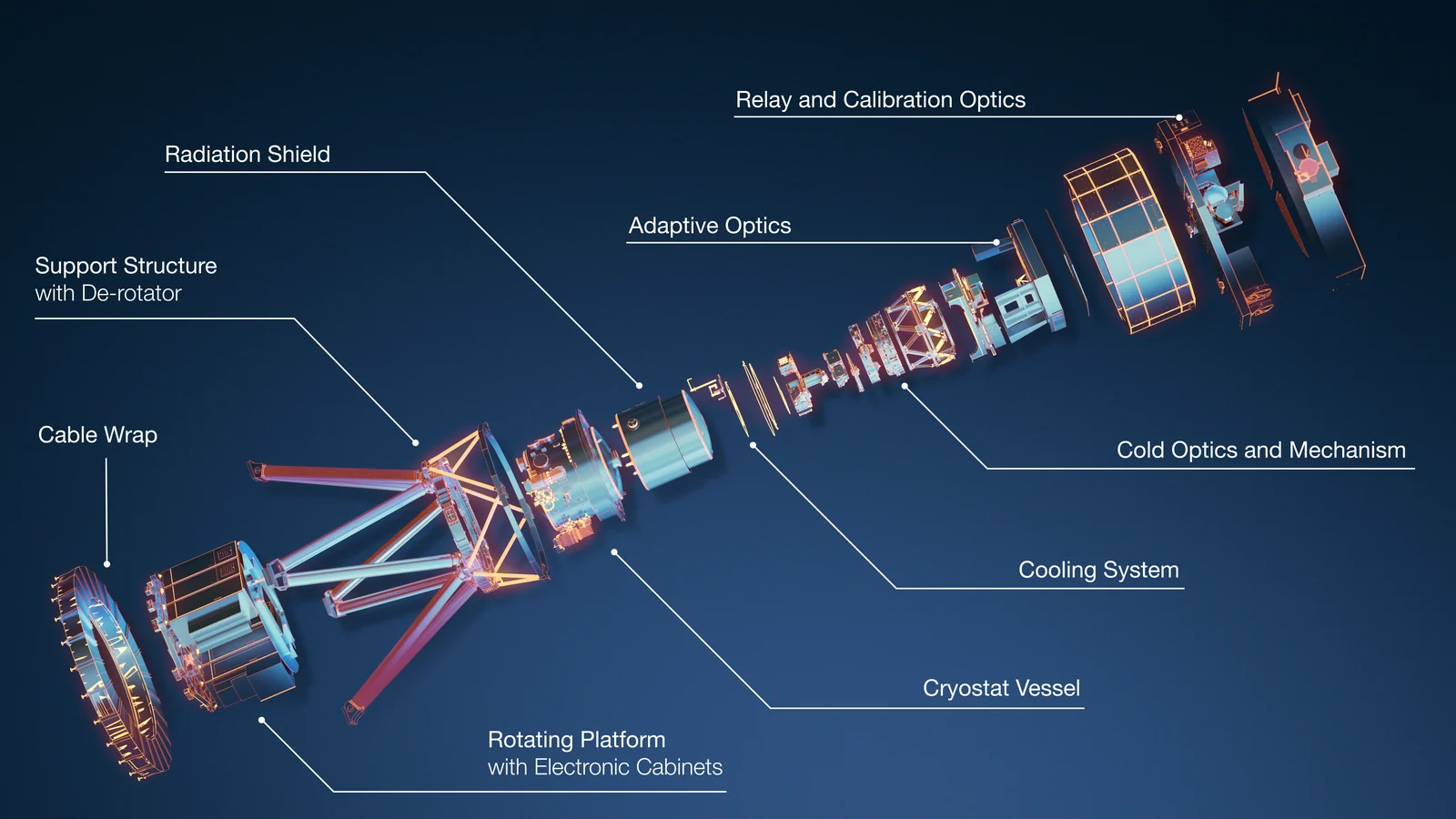 Inside MICADO, the ELT’s near-infrared camera.ESO/MICADO consortium/L. Calçada · CC BY 4.0ESO engineering illustration · resized and converted to WebP.
Image source & licence
ESO ann24013d
eso.org/public/images/ann24013d/
creativecommons.org/licenses/by/4.0/
From telescope to instrument
The telescope gathers light; instruments such as MICADO turn it into scientific images and spectra. Adaptive optics compensates for atmospheric turbulence.
Sources & references
- elt.eso.org/about/
- elt.eso.org/about/facts/
- elt.eso.org/instrument/MICADO/
ASTRONOMY & SPACE
UPLIFT connects lightweight tank structures with cryogenic testing for liquid-hydrogen applications. CRYOVAC and ArianeGroup are development partners of DLR for the test rig.
Test before assembly
DLR tests composite tank domes for structural performance and gas-tightness before assembly. Controlled cryogenic conditions help assess materials for future hydrogen aviation.
Sources & references
- event.dlr.de/ila2026/uplift-tank-test/
- www.dlr.de/de/sy/forschung-transfer/forschungsinfrastruktur/projekt-uplift-saeule-c-kryogene-techniken
TEMPERATURE METROLOGY
Primary thermometry relates temperature to measurable physical quantities. Dielectric-constant gas thermometry uses the electrical response of a gas as pressure changes.
A stable experimental environment
A cryostat provides controlled thermal conditions for the experiment. The papers explain measurement methods; their uncertainty figures do not specify this individual CRYOVAC system.
Publications
Context & publication summaries- 01
C. Gaiser, B. Fellmuth & N. Haft · 2008
Primary Dielectric-Constant Gas Thermometry in the Range from 2.4 K to 26 K at PTB
A PTB study comparing primary gas-thermometry measurements with ITS-90 at low temperatures.
DOI 10.1007/s10765-007-0318-4 · International Journal of Thermophysics 29, 18–30
- 02
C. Gaiser, T. Zandt & B. Fellmuth · 2015
Dielectric-constant gas thermometry
A review of the physical principles, experimental techniques and results of DCGT.
DOI 10.1088/0026-1394/52/5/S217 · Metrologia 52, S217–S226
Sources & references
- www.bipm.org/documents/20126/237262613/SI-App2-kelvin-2024-TG-Dig-revision/1444eda0-9ec1-7917-9eb7-41bc0d73e23a
- doi.org/10.1007/s10765-007-0318-4
- link.springer.com/article/10.1007/s10765-007-0318-4
- doi.org/10.1088/0026-1394/52/5/S217
- www.ptb.de/cms/fileadmin/internet/publikationen/ptb_news/pdf/englisch/PTBnews_2016_1_e.pdf
TEMPERATURE METROLOGY
ITS-90 gives laboratories a practical temperature scale. PTB realises and transfers it using fixed points, gas and vapour-pressure thermometry, and resistance thermometers.
Scale and thermodynamic temperature
Primary measurements allow comparison with thermodynamic temperature. Calibration then connects everyday thermometers to established reference measurements.
Sources & references
- www.ptb.de/cms/en/ptb/fachabteilungen/abt7/fb-74/ag-743.html
TEMPERATURE METROLOGY
Polarizability describes how a gas responds to an electric field. Knowing it accurately helps connect electrical measurements with pressure and temperature.
Helium, neon and argon
The PTB study investigates these noble gases using dielectric-constant gas thermometry. The resulting reference data support gas metrology and tests of theoretical calculations.
Publications
Context & publication summaries- 01
C. Gaiser & B. Fellmuth · 2018
Polarizability of Helium, Neon, and Argon: New Perspectives for Gas Metrology
Experimental noble-gas polarizability values for pressure and temperature metrology.
DOI 10.1103/PhysRevLett.120.123203 · Physical Review Letters 120, 123203
Sources & references
- doi.org/10.1103/PhysRevLett.120.123203
- journals.aps.org/prl/abstract/10.1103/PhysRevLett.120.123203
- tsapps.nist.gov/publication/get_pdf.cfm?pub_id=926683
Partner overview
Free-piston Stirling engines and cryocoolers.
CryoTel GT
Stirling cooling in a compact package. The CryoTel GT from Sunpower delivers a nominal 16 W at 77 K with a reject temperature of 23 °C. We help define the configuration and integration for your application. The image shows the base model.
- Nominal cooling capacity: 16 W at 77 K, reject temperature 23 °C
- Nominal input power: 240 W
- Power supply: 48 V DC
- Base model: 3.1 kg · 276 mm length · 83 mm diameter
Partner overview
Superconducting magnets, cryogenic systems and related instrumentation.
United States and Canada
Rickmer Kose, Sven Kelling
182 Howard
San Francisco, CA 94105, USA
+1 (415) 817-9871
sales@sentys.com
China
Hao He
Room 1310, Air China Plaza
No. 36, Xiaoyun Road, Chaoyang District
Beijing 100027, P. R. China
+86 10 8069 8356
info@be-instruments.com
India
Darus Mack
1520 – 15th Floor, Maker Chambers V
Jamnalal Bajaj Marg, Nariman Point
Mumbai 400 021, India
+91 (0) 22 22855261 / 22834962
darius@mack.in
We will be happy to discuss this reference with you. Product and project information is available here on our website.
 low temperature technologies
 PRECISION, DOWN TO THE DETAIL.